GHK-Cu and the Science of Copper Peptides
Why a small blue tripeptide became one of the most-studied compounds in dermal research.
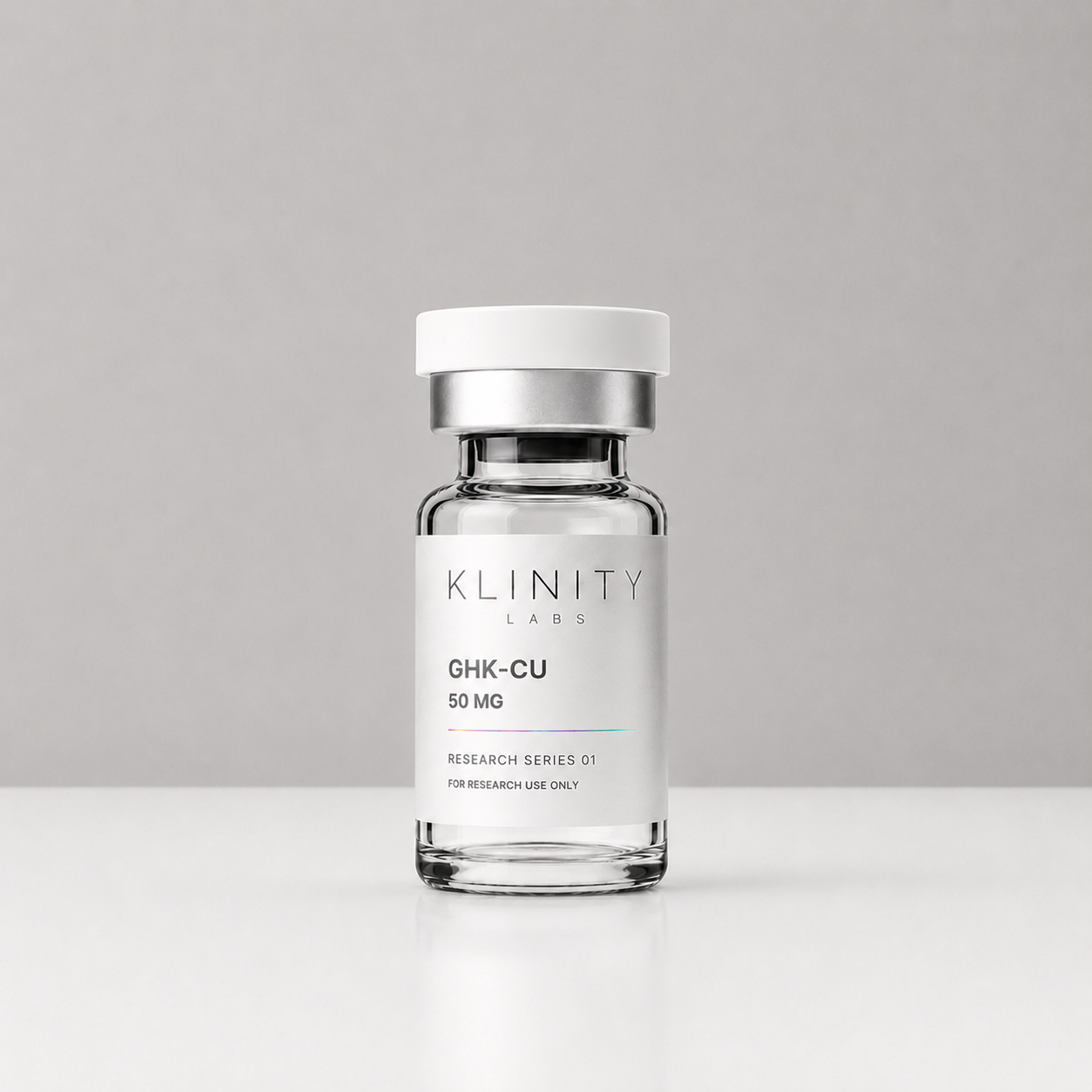
Among dermal research compounds, few have as long a literature history as GHK-Cu. It is a tripeptide — three amino acids, glycine, histidine, and lysine — with a strong natural affinity for copper ions. That bound copper gives solutions of GHK-Cu their characteristic blue color and is central to how the molecule behaves.
Structure and Copper Binding
The copper-binding property is not incidental; it defines the molecule. The histidine residue coordinates a copper ion, and this metal-peptide complex is the form studied in the dermal-remodeling and collagen-synthesis literature. Verifying copper-binding integrity is therefore part of a meaningful quality check for this compound.
Research Context
GHK-Cu appears across research examining extracellular-matrix remodeling and the expression of genes associated with tissue maintenance. It is also a common component of formulated research blends, where it is combined with repair-oriented peptides.
Handling Notes
Because the copper complex is light-sensitive and the peptide structure is delicate, GHK-Cu is stored lyophilized and protected from light, then reconstituted carefully following standard handling practice. As with all Klinity Labs compounds, it is supplied for laboratory research use only.
This article is educational and informational only. It does not constitute guidance for the use of any compound. All Klinity Labs compounds are supplied for laboratory research use only.